
(Manfred Klimek / Photo: Ludwig von Kapff – Weinhandel)
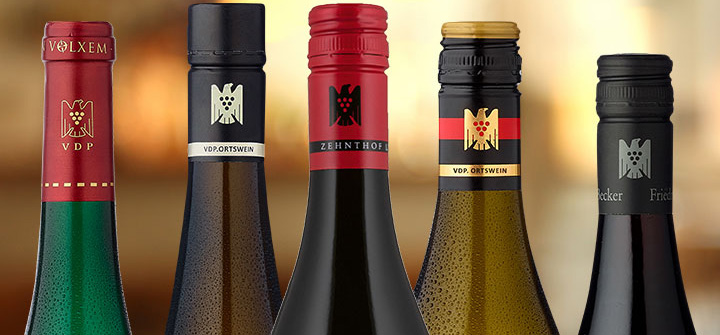
The Association of German Prädikat Wine Estates, or VDP for short, has set standards for decades. It was at the forefront when others were still pondering how to market Germany’s quality wines. Yet the symbol that has accompanied it for almost a hundred years has become a problem in an age that is far more sensitive to symbols than ever before: the eagle.
This bird, with its stiff wings and menacing talons, is a grim reminder of what it should never again symbolise – the Imperial Eagle. A historical burden that my generation was still able to view in the abstract, because we could separate the symbolic from the symbol itself. But this ability is fading. We live in an age in which the obvious supplants the thoughtful and the nuanced.
What you see is what counts. And what looks like power is regarded as a gesture of power.
What looks like an Imperial Eagle remains an Imperial Eagle – regardless of what the articles of association say, regardless of how liberal and, as they insist, democratic the winegrowers are. Tradition is all well and good. But can the Reich eagle in disguise – which has always put consumers off, as I learnt from fellow journalists back in the 2000s (“I won’t buy that; it reminds me of the Nazi era”) – cannot be a symbol that still holds sway in a changing society.
So if the VDP does not want to lose touch with the younger generations, it must democratise this eagle. It does not necessarily need a new heraldic animal – but at least a reinterpretation: softer lines, less armour, more of a contemporary feel. Why not a tongue-in-cheek eagle clutching a glass and a bottle in its talons? A symbol that doesn’t dominate, but savours the moment.
Otherwise, the proud heraldic bird will become an SUV with wings – the perfect symbol of the very masculinity that Generation Z is currently turning its back on. Then the eagle is no longer an emblem, but a warning sign. Especially abroad, where German wine urgently needs to be positioned as youthful.
Speaking of rebranding: whilst half the wine world is currently trying to invent the concept of ‘low alcohol’, the solution has been lying in German cellars for centuries: Kabinett and Feinherb.
These wines – light, elegant and inviting – are the antithesis of those alcohol-laden heavyweights that once promised prestige but now merely induce fatigue. A good Mosel Kabinett has 7.5 to 10 per cent alcohol, balances residual sweetness with acidity, tastes like an afternoon in the autumn sun and yet still has depth.
It is the ‘wine of the future’, without anyone needing to invent a marketing term for it.
But why isn’t anyone capitalising on this?
Why not stick a label on every bottle in the colours black, red and gold, bearing the phrase:
‘Low Alk. Big Fruit. Decent Glass.’ – an ironic, self-assured slogan that signals exactly what Germany is capable of: wine with both character and lightness.
Instead, paralysis reigns. The associations are afraid to modernise. Winemakers fear losing their sense of seriousness. And the VDP, which could actually be truly bold on this issue, is preoccupied with classifications as if it were a matter of administrative law rather than joie de vivre.
Yet Germany has always been at its best when swimming against the tide: when sweet and dry wines were (and still are) produced with equal brilliance on the Moselle. When Rieslings were exported that went on to become absolute premium wines in England and the USA. And today, as the world cries out for lighter, more approachable wines, Germany looks on sheepishly as even regions such as sleepy Provence dominate the ‘Light & Fresh’ category.
Both topics – the Adler and the Kabinett – go hand in hand.
Both reflect an industry at peace with itself, whilst everything else is in flux.
The eagle shows just how hard it is to embrace change.
The Kabinett shows just how easy change could be.
Germany could shake up the wine world with two simple gestures:
a new, contemporary eagle – and a national show of solidarity behind light, lively Riesling.
Does the German wine industry want such adaptive and simple reforms? Or does it want to sit back and watch from the front row as it disappears?
More depends on this decision than is realised today. A ‘carry on as before!’ approach would be disastrous.