
(Gerhard Retter: text & photos; editorial team; AI-generated main image)
Seen from the outside – that is, from the street and in terms of its image – Louis Roederer is a classic, time-honoured champagne house with a reputation and a name that carries weight. It might even sound like something rather stodgy, evoking brass plaques and marble halls. In reality, however, Roederer is the exact opposite: a house that proves that greatness need not be ponderous, and that greatness does not mean simply producing everything in the traditional way.

The Collection – an entry-level cuvée with ambition
The Collection is officially the house’s ‘simple’ champagne. Unofficially, however, it already shows just how little Roederer has in common with simplicity. Jean-Baptiste Lecaillon, the cellar master, prefers to call it ‘Multi-Vintage’. It sounds like marketing, but it’s actually more astute: a blend of several vintages (as is customary in Champagne), which nevertheless embodies the house’s signature style and core character. Each release is a new chapter – yet all bear the same distinctive hallmark. It’s almost like leafing through a family album.

Jean-Baptiste Lecaillon – visionary and realist
Jean-Baptiste Lecaillon is regarded as one of Champagne’s most influential visionaries. But he is no prophet in a cellar apron, rather an architect in wellington boots. Biodynamics, biodiversity, permaculture – for him, these are not just buzzwords for PowerPoint presentations, but tools for everyday life. He speaks about climate change as enlightened people do: concretely, calmly, without false comfort. Under his leadership, Roederer is becoming a pioneer – not with grand speeches, but with precise steps – with precision.
Cristal and the Vinothèque
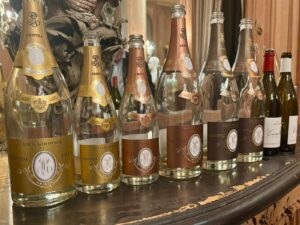
Cristal is the icon, of course. But whilst other icons gather dust on pedestals, Cristal remains alive. Salty, fresh, radiant. The Vinothèque goes even further: bottles matured for over 20 years, demonstrating that time does not mean weight, but depth. Anyone who tastes them realises: champagne can age with dignity, without losing its power and lustre.
Camille – still wines with a mission
And then there’s Camille. A project that doesn’t sound much like champagne at all – because it’s a still wine: what people usually recognise as ‘ordinary wine’ – rather than a promise of luxury and trends. White (Chardonnay) and red (Pinot Noir) from the Côte de Champenoise, named after a grande dame of the House of Roederer. Why all this? Because Jean-Baptiste Lecaillon recognises that climate change, in his already very north-eastern French region, offers still wines a future. The Camille wines demonstrate what is essential here: consistency.
The lightness of greatness
Perhaps the most remarkable thing about Roederer is that, despite all their depth, the wines come across as light. No intellectual posturing, no opulent heaviness. Instead, they are lively, easy to drink, almost playful. Luxury without ostentation – almost indecently normal.
Ultimately, Roederer is more than just a champagne house. It is a statement: responsibility can be a delight, innovation can be elegant, and greatness can be expressed with playful elegance.
And right at the heart of it all: Jean-Baptiste Lecaillon, the man who proves that vision and down-to-earthness are no contradiction – and who is shaping the champagnes of the future.