
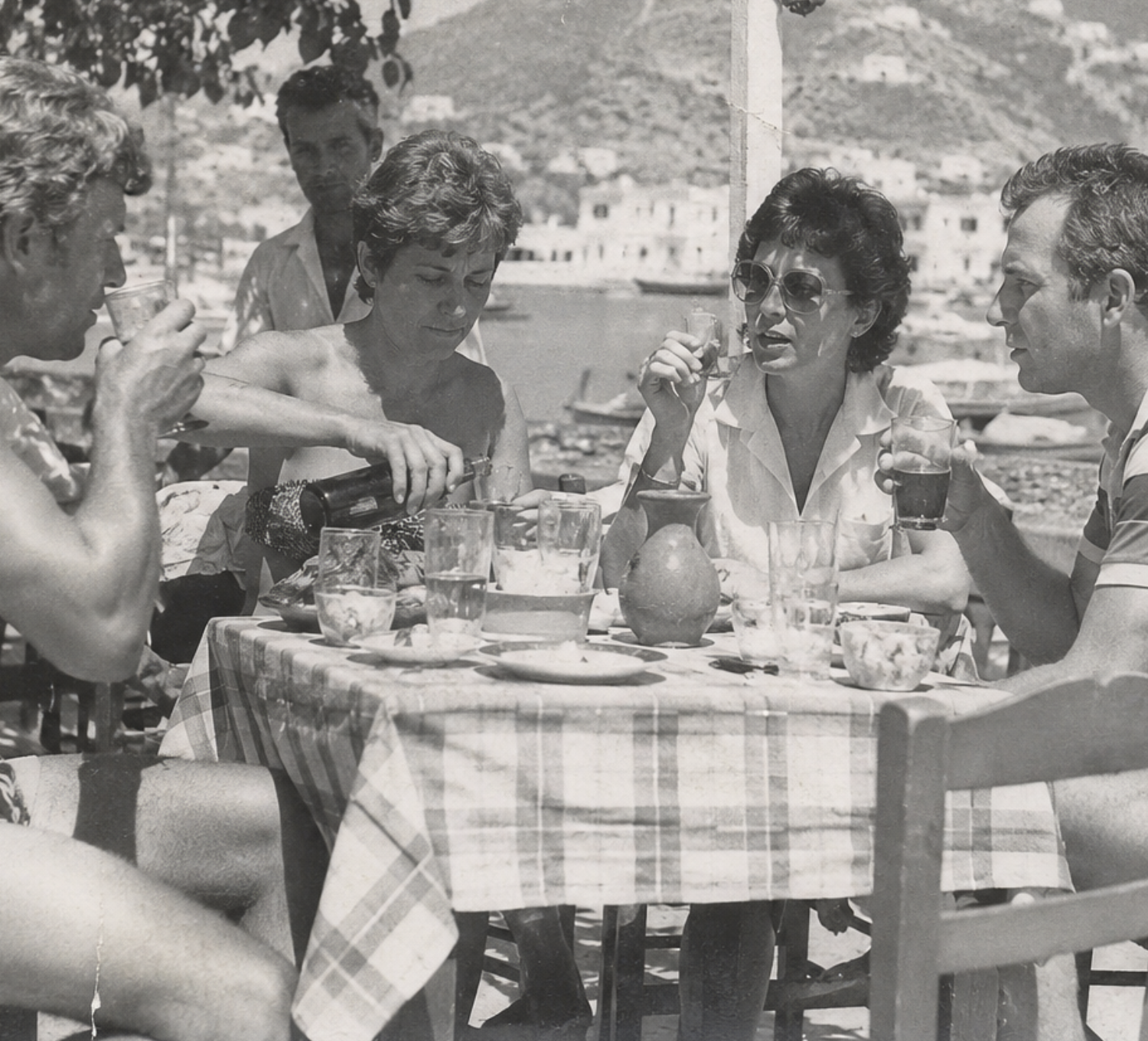
(Gerhard Ziegler / pic: historical archive)
An evening on a terrace in Larnaca. Leo pours something red, the wine foams slightly, smells clean, fresh and rather seductive; I guess Italy and am at least not completely wrong, although I am wrong about everything else. After several failed attempts, Leo grins and reveals the answer: Lambrusco. This unsettles me more than it should, because until then I had mainly associated that name with sweet evenings in my youth, lipstick, first infatuations and the slightly unsteady journey home to catch the last tram. Such memories run deep, including with wine, and sometimes prevent us from taking a closer look again for decades. That was the case with Lambrusco. With Retsina, even more so.
In the early nineties, probably 1991, I flew to Greece with friends after leaving school, one of my first flights ever, then on to Athens and further by hydrofoil, whose paintwork had already accounted for a considerable proportion of its perceived stability even then, to Poros. We were around twenty, some younger, had little money, lived simply, met some easy-going American girls and found a taverna we could afford every evening. It was called Papas Stamatis, and the owner carried food, talked, laughed, swore, topped up our glasses and seemed to be permanently in a good mood. The problem was in the carafe. His house wine was Retsina, priced exactly where we needed it to be, but in terms of flavour it was in a place I have not forgotten to this day. The resin of the Aleppo pine completely dominated, joined by nail-polish remover, glue, a hint of grape somewhere in the background and an effect that reliably lasted until the following morning. Our conversations in English were not improved by it in the slightest, nor was our condition at breakfast. The fact that we nevertheless ordered it again for several evenings in a row can only be explained by youth, lack of money and the astonishing physical resilience of those years. After that, Retsina was finished for me. In Greek restaurants in Vienna, I ordered Austrian or Italian wine and left the resinous past to rest.
More than three decades later, after sunset, I am sitting on the terrace of the “Vintage” in Nicosia, the divided city before us; a few streets away, the Turkish-controlled north begins, and suddenly Retsina is in the glass again. This time, nothing needs to be overcome. The wine smells of Mediterranean herbs, citrus peel and a touch of salt, possesses freshness, structure and astonishingly precise spiciness; the resin remains in the background and gives the wine something of its own that becomes completely natural after a few sips. Modern Retsina has changed enormously in technical and qualitative terms. Ambitious producers work with high-quality grapes, often Assyrtiko or Roditis; the resin of the Aleppo pine is added only in small quantities during fermentation and then removed. The former dominance disappears, leaving spice, freshness and that distinctive aromatic character which makes these wines immediately recognisable. From a drink that for many travellers belonged for decades to a cheap Greek holiday, the best producers have created a serious wine category.
Anyone who would like to try it will now find plenty of opportunity. Ritinitis Nobilis from Gaia is made from Roditis and shows what precision can do with this ancient tradition. Tear of the Pine from Kechris is based on Assyrtiko and is among the most ambitious representatives of the category, Retsina Amphora Nature from Tetramythos brings Roditis and ageing in amphorae together, Nimbus Ritinitis from Kamara takes a more herbal and idiosyncratic approach. None of these wines calls for nostalgic indulgence, and none needs the excuse of a long tradition. Today, they stand in the glass on their own merits and work brilliantly with Greek cuisine, fish, vegetables, herbs, grilled meat or simply late in the evening on a terrace in Nicosia. For me, there is a small consolation in this: not every bad wine from our youth has remained bad. Sometimes the wine has moved on while we had long since stopped asking about it. And sometimes it takes thirty years, a different place and a single glass to finally settle an old score.
Vintage Wine Bar & Bistro
Ermou 285
1017 Nicosia
Cyprus