
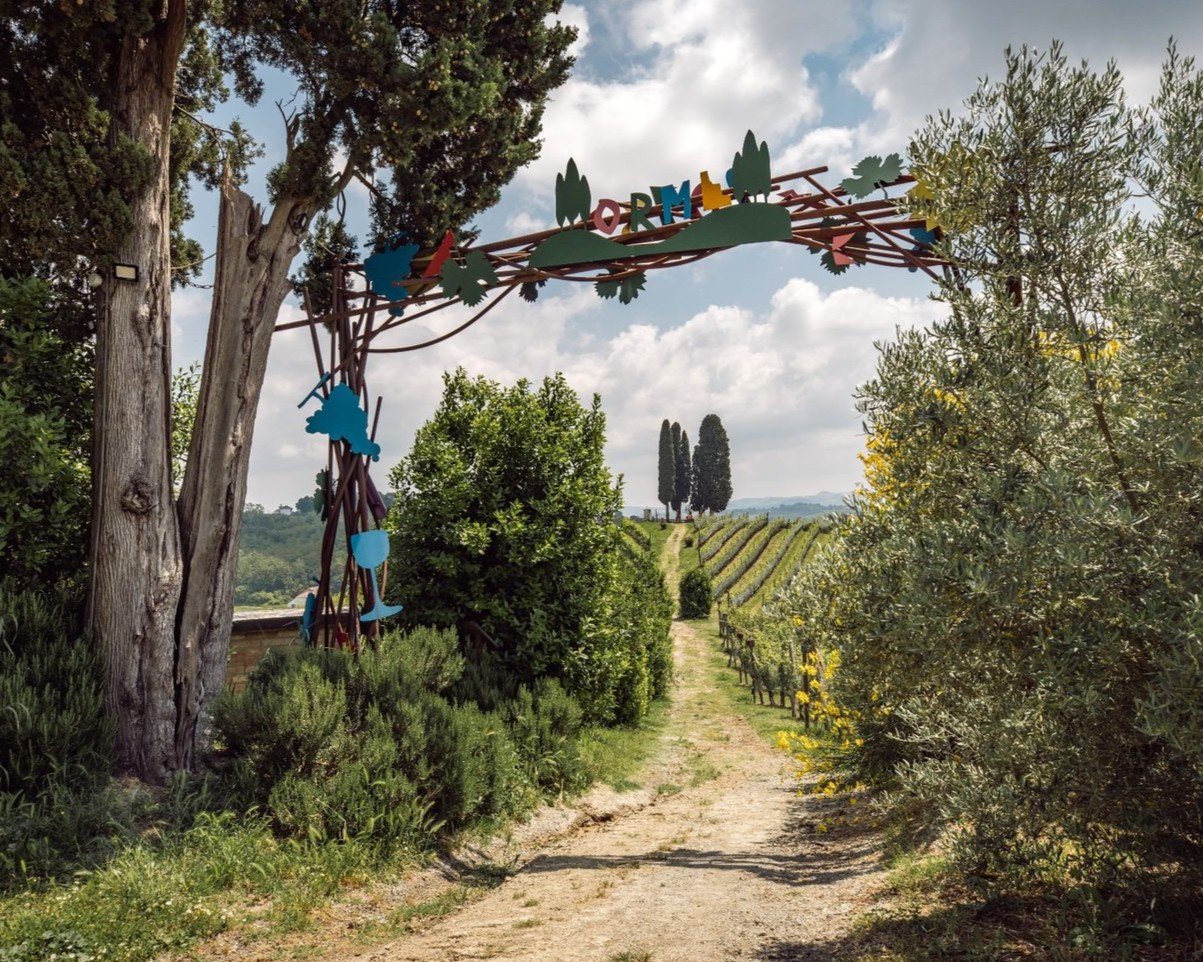
Landscapes, photographed until the memory card is full: Piedmont. These hills, which look as though an Italian landscape architect had worked with green velvet and edging. Vineyards stretching in long, precise lines across hilltops and slopes. In between, castles, church towers, old houses with terracotta roofs and those cypresses that apparently always grow wherever photographers need them. In autumn, mist lies in the valleys. It smells of firewood – that smoke which romanticises the soul. Above the mist, the hills rise like islands from a white sea. And: when will the first white truffles appear?
Here, between the Langhe and Monferrato, lies one of the world’s most precious wine regions. And right in the middle of it works a family whose name has stood on bottles for seventy years, bottles found in practically all the important wine markets: Michele Chiarlo. A well-known name. A big name, in fact. Yet in conversations about Piedmont’s truly great winemakers, it surprisingly seldom comes first. Why is that?
When the aristocracy of Piedmontese wine is discussed, the names Gaja, Giacosa, Conterno, Mascarello, Vietti, etc. reliably come up. Understandably so. These producers have created wines that have made history; their bottles are coveted, their best vintages bloody expensive (but still – apart from perhaps Gaja – affordable), their names endowed with an aura that long ago detached itself from the bloody delicious liquid in the glass.
Michele Chiarlo’s wines were always present, his company visible, his name internationally widespread, his wines in the best restaurants (especially in New York). Anyone available everywhere cannot be a hidden gem. But the wine world loves hidden gems. Preferably ones that cost 800 euros and have not accepted any new customers for twenty years. So how do you explain that a non-hidden gem is nevertheless a hidden gem?
Cerequio. Cannubi. Asili. Faset. Plus La Court. This is no ordinary list of crus. It is a stroll through the better slopes of Piedmont.
Let us begin with Cerequio. The vineyard lies between La Morra and Barolo and is one of the appellation’s historic top sites. A partially amphitheatrical expanse of vines, whose slopes open themselves to the light and whose differing exposures and soils give Nebbiolo remarkable complexity. Cerequio can produce that rare combination of power, fragrance and weighty elegance for which great Barolos are famous. Chiarlo arrived here in 1988, relatively late.
Cannubi followed a year later. Anyone concerned with Barolo knows the name. Cannubi is one of the region’s most famous and historically esteemed vineyards. Its position slightly above the village of Barolo, its soils and its reputation make the wines from here the Grand Crus of Piedmont, even if Italian classifications work differently from those in Burgundy. Cannubi is one of those vineyards where the address alone explains a considerable part of the bottle price. The rest has to be delivered by the winemaker.
Then Asili and Faset in the Barbaresco area. Asili is counted among the classic great sites of this appellation, known for its combination of aromatic finesse, structure and remarkable longevity. Faset is also near Barbaresco and possesses an individual character; in my opinion, it used to be fun to drink earlier. Both wines prove that Chiarlo by no means limits his idea of great single vineyards to Barolo – where winemakers can charge more.
And finally Monferrato. La Court, the estate near Castelnuovo Calcea that Chiarlo acquired in 1995 – another important source for Barbera. This is where a second part of the story begins. One that may even be more important than the famous B & B sites.
When Michele Chiarlo founded his winery in 1956, at just 23 years of age, Barbera was primarily an everyday wine. People drank it with meals, they drank a lot of it, and they did not necessarily think about whether they should forget a bottle in the cellar for twenty years. Barolo already had its history and its nobility. Barbera had the thirst.
Chiarlo was one of those producers who wanted to change that. He began treating Barbera as a serious quality wine. With lower yields, targeted work in the vineyard, careful selection of the grapes and an increasingly precise understanding of which sites could produce which wines. In the eighties, among other things, the company adopted green harvesting, meaning the deliberate removal of grapes in favour of quality. What today belongs to the (also questioned) standard repertoire of ambitious winemakers was by no means self-evident then.
Above all, though, Chiarlo asked a question that Piedmontese viticulture had asked itself far too rarely for a long time: Why should Barbera not be able to speak just as powerfully of its origins as Nebbiolo?
The answer led via individual top sites and the elevation of Barbera d’Asti ultimately to the creation of the Nizza DOCG appellation. Chiarlo was one of the driving forces behind this development. The fact that Nizza now stands for particularly special Barberas is also his achievement. We need to appreciate the scale of this work. Acquiring a famous vineyard and making a great wine from it is a considerable achievement. Helping an entire grape variety develop a new sense of itself is a greater order of magnitude.
And this is precisely where the comparison with Angelo Gaja becomes interesting, because Gaja repositioned Piedmontese wine internationally. He shifted quality standards, broke with traditions, changed the perception of Barbaresco and made his name one of the strongest brands in Italian wine. That is beyond dispute.
Chiarlo took a different path. He combined work on famous Nebbiolo sites with an attempt to secure a long-underestimated grape variety the place it deserved. He built international markets, brought Barbera to North America and Asia, and helped turn a regional everyday wine into a respected wine of origin.
Which of the two is greater? That depends on what one means by greatness. The highest price? The most famous bottle? The most lasting transformation of an entire wine region? Or the ability to produce good wines over decades without catering exclusively to a small community of wealthy collectors? That is a question one can argue about admirably over a bottle of Barolo. Ideally over a second one.
Michele Chiarlo died in 2023. Today, his sons Stefano and Alberto run the company. They have taken over not only the vineyards but also a rather unconventional idea of what a winery can be. In 2003, an art park was created among the vines at La Court. In 2011, the Palás Cerequio opened: a small relais dedicated to Barolo in one of the region’s most famous sites. In 2024, an art trail designed by Ugo Nespolo was added on Cannubi Hill.
Purists wrinkle their noses at this: art in the vineyard, hotels among the vines, walking paths for visitors. After all, the purist wants great wines to be made in cellars that are as inaccessible as possible, whose owners fundamentally have no time to answer the telephone. On the other hand, Piedmont is also a cultural landscape whose future depends on the interplay between agriculture, tourism and regional identity. Chiarlo understood that early on.
For its seventieth anniversary, the estate is now focusing on thirty vintages of its Barolo Cerequio. The project is called Cerequio30. Three decades of a wine from a single vineyard. That is a better anniversary celebration than the usual speeches, during which after twenty minutes one can only hope that someone will finally open the bottles.
Because with Nebbiolo in particular, time is a decisive part of quality. A young Barolo is stern, closed and unyielding. Over the years, of which we have fewer left in old age, this changes: the tannins become finer, the fruit recedes, and in its place come those aromas of dried herbs, leather and tobacco that make a great mature Barolo one of the most fascinating red wines in the world. Thirty vintages from Cerequio are therefore also thirty attempts to understand the same place under different conditions each time.
Seventy years after its foundation, Michele Chiarlo is a company whose significance should not be measured solely by the prices of its most expensive bottles. Its story tells of how regional wine became international top-quality wine. How Barbera was able to become a serious single-vineyard wine. And how a winemaker realised early on that the future of Piedmont lies exclusively in its individual vineyards.
So is Michele Chiarlo the undiscovered grand master of Barolo? Undiscovered would be an exaggeration. His name is far too well known for that. Underestimated is more accurate.
And greater than Gaja? I would not simply blurt that out as a provocation. Or perhaps I would not. To do so, I would have to set the great vintages of both estates side by side, compare the best sites and take a great deal of time. Such a tasting would, of course, be entirely impartial and exclusively in the interests of wine journalism. Yes: this is not a request but an instruction!