
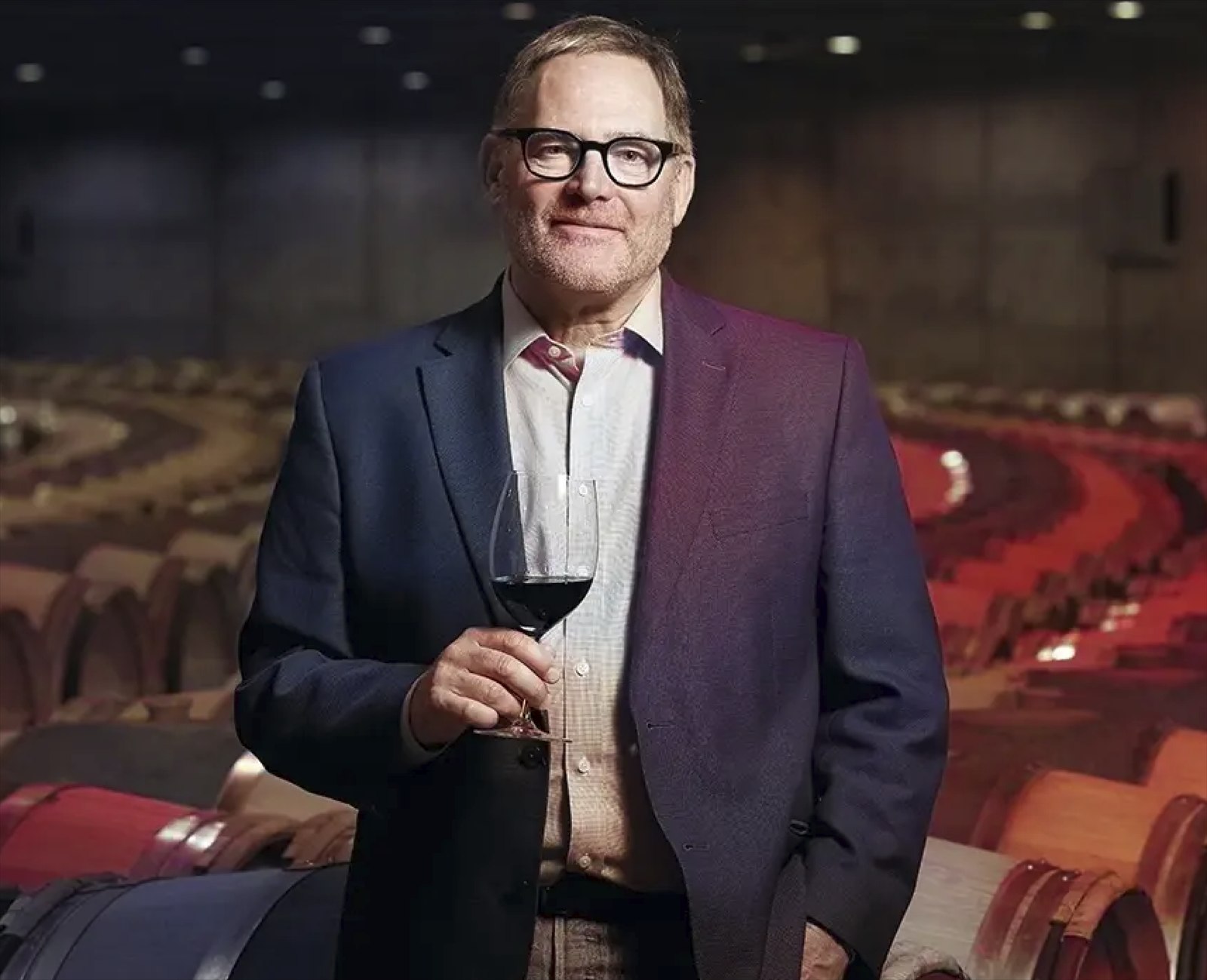
We arrive at Opus One in the middle of harvest. Michael Silacci actually has other things to do, but nevertheless takes the time to meet us. He guides us through the vineyards and cellar, lets us taste musts and fermenting lots, and finally sits down with us for a tasting. Silacci will retire in July 2027; 2026 is his final harvest. He has been responsible for Opus One since 2001. Making one of California’s and the world’s most famous wines for 25 years is quite a career. Leaving the wine in better shape afterwards is the greater achievement.
Opus One is an astonishing place. The building in Oakville, with its limestone, arcades and austere geometry, carries French genes, while above it stretches this vast Californian sky. The hospitality also operates according to both systems. French form meets American generosity. Our specially printed menu reads “Mr. and Mrs. Gerhard Retter”. A small correction: Cornelia and I are not married. Nor were we spontaneously married in Las Vegas on this trip. Not yet.
We drink from Zalto Bordeaux, my favourite glass. Glass covers rest on the filled glasses. They are removed one after another, allowing the wines’ development to be followed more precisely. Executive Chef Sean Koenig serves a savoury Mont Blanc with duck liver and peach, Gruyère gougères with sweetcorn and truffle, as well as gazpacho made from heritage tomato varieties, Meyer lemon and spruce shoots. Small dishes, precisely matched to the wine. At Opus One, little is left to chance.
That was already the idea in 1978. Baron Philippe de Rothschild of Château Mouton Rothschild and Robert Mondavi decided then to produce a great wine together in Napa. The first vintage was released in 1979. Opus One was not intended to be a Bordeaux replica. Robert Mondavi was probably the wrong man for that anyway. And Philippe de Rothschild had hardly come to California to produce Mouton beneath the palms. The exciting part lay in the collision of two wine cultures: French thinking in terms of origins, cuvées and generations on the one hand; Californian enthusiasm for experimentation and technology on the other.
That tension has remained. Opus One does not taste like Bordeaux, nor, in its best vintages, like that overripe Napa Cabernet after which the napkin sticks to the table after one glass. Silacci wants the wine’s origin to be narrowed down ever more precisely: New World, Napa Valley, Oakville, Opus One.
A substantial part of the vineyards lies in To Kalon. Around 100 of Opus One’s 170 hectares of vineyard are located there. I consider To Kalon a cru, even though Napa has no European-style classification to support this. The Mayacamas alluvial fan has left behind a complicated mosaic of gravel, sand and clay, along with volcanically influenced sections. For Silacci, these differences are working materials. Parcels are considered separately, clones are adapted and harvest dates are determined individually.
These days, climate is what occupies him most. Napa has never lacked sunshine, but now there can be decidedly too much of it: heat, drought and sunburn alternate with torrential rain and the notorious atmospheric rivers. Opus One is therefore experimenting, among other things, with the Gravesac rootstock, whose roots are intended to cope better with both dry and very wet periods. Rows of vines are being realigned. Morning sun can be more favourable than the aggressive heat of the afternoon. Drones survey the land. A block in front of the winery was planted in a sweeping formation and is known internally as “Swoosh”, because light and shade are distributed more favourably there. At Atlas Peak, the vines are trained so that the shoots form a kind of umbrella over the grapes.
All this technical effort pursues a decidedly old-fashioned goal: the wine should taste good.
In 2022, that became difficult. At the beginning of September, an extreme heatwave swept across Napa. Silacci had to decide whether to wait or harvest. And now Rihanna enters the story.
Her song “Umbrella” was apparently playing in his head at the time. In it, Jay-Z raps: “We fly higher than the weather.” Silacci decided to do exactly that and get ahead of the weather. He began harvesting early. At the same time, he refrained from reducing the yield further through a late green harvest. His reasoning: in extreme heat, the vine would be better off distributing its energy across more grapes. Fewer fruits might have driven the remaining berries towards overripeness even faster.
Not everyone at the estate was enthusiastic. Silacci went ahead anyway.
The 2022 shows that the decision was the right one. Cassis, dark berries, dried rose petals, graphite, olive and cedarwood. Despite 18 months of ageing, the new French oak remains remarkably gently integrated. Fine tannins, sufficient acidity, juicy fruit. Above all, it lacks the cooked sweetness one might expect after such a weather year. The wine is made up of 80 per cent Cabernet Sauvignon, along with Petit Verdot, Cabernet Franc, Merlot and 0.5 per cent Malbec. Harvest began as early as 24 August.
I like the 2019 even better. Perhaps I have never tasted Opus One better at all. Dark fruit, tremendous tension, very fine tannins, perfectly integrated oak. The wine is dense and powerful, yet remains supple. The 2012 is already further along. Cassis, forest floor and graphite, silky tannins, still vibrant acidity. It has reached a wonderful drinking age and should nevertheless continue effortlessly for another twenty years.
Before that comes Ouverture 2022 in the glass. Ouverture used to be bottled as a non-vintage blend, but it now also carries a vintage. Ninety-four per cent Cabernet Sauvignon, 18 months in new French oak, 210 dollars ex-cellar. “Entry-level wine” would be an expression of Californian humour at this price. The current Opus One, however, costs 490 dollars. And suddenly Ouverture is almost a bargain.
Silacci has continually changed Opus One during his 25 years there. Spontaneous fermentations with yeasts from the estate’s own vineyard parcels, clone blends, new parcel divisions, different rootstocks and vine-row orientations have been added. He speaks of it without the manner of a great innovator. One sentence stays with me: you never reach the point at which you can say that you now have “the” answer.
That is probably the most sensible sentence a winemaker at a famous estate can utter.
It has not yet been decided who will succeed Silacci. Meghan Zobeck, Director of Winemaking since 2025 and the first woman to hold this position at Opus One, is among the possible candidates. The search is international. Silacci himself evidently has no intention of playing nothing but golf afterwards. He has spoken to American media about small personal wine ventures—perhaps Sauvignon Blanc, perhaps Cabernet from Rutherford or Oakville. He can even imagine studying Method Acting in New York. Robert De Niro is waiting.
After 25 years at Opus One, something different is quite permissible.
The question remains: how much change can an icon take? Silacci has answered it rather convincingly: under his responsibility, work has been carried out on yeasts, clones, rootstocks, plantings, canopies and harvest dates. These days, surveillance drones fly over To Kalon. And in a difficult year, even Rihanna can help with the harvest decision.
Only one thing must not be lost in all this. The wine must continue to taste like Opus One.