
On 30 May 1987, something happened in Vienna that hardly anyone noticed, either outside or even within the city. A railway line that had lain dormant for forty years was reopened. The connecting railway between the suburban regional-transport and underground stations of Heiligenstadt and Hütteldorf, popularly known as the Vorortelinie, was given the status of a city S-Bahn line as the S45, and today it is the only railway line in the Austrian capital to have remained virtually undiscovered by the millions of tourists. Yet what we can discover to the left and right of the Vorortelinie is certainly worthy of a tourist’s attention: it is authentic Vienna, rougher and sometimes a touch shabbier than the wealthy districts within the Ring and the city centre shaped by the buildings of the Habsburg monarchy. Rougher, sometimes shabbier. But maximally authentic.
The line was built at the end of the nineteenth century as part of the Vienna Stadtbahn planned and realised by Otto Wagner. Wagner designed not only the stations but a total work of art combining transport, architecture and urban planning. Heiligenstadt, Oberdöbling, Hernals, Ottakring and Hütteldorf were building blocks of a modern metropolis. To this day, the stations are listed buildings. Anyone travelling on the Vorortelinie is not merely passing through Vienna’s western outskirts, but through a piece of European transport architecture from the Gründerzeit.
After the Second World War, however, the line increasingly fell into disrepair. The city focused on other transport corridors. The Vorortelinie lost importance, was partly closed and slowly became overgrown. Bridges rusted, stations decayed, and some sections looked more like sets for a post-industrial film than part of a major city.
Four decades later, it passes through that Vienna which still largely belongs to itself. Especially in Ottakring and Hernals, one encounters a city in which immigration from the former Yugoslavia has long since become part of everyday life. The ćevapčići stall stands beside the traditional pub. The Serbian butcher beside the Weinviertel baker. The children speak Viennese with those nuances that each generation adds anew. Much of it seems remarkably self-evident. Here, coexistence is often practised rather than integration – an approach with which Vienna has fared better than Paris or London.
Something else is even more remarkable: along the Vorortelinie, one frequently comes across those architecturally interesting municipal housing estates commissioned by so-called Red Vienna between 1919 and 1933. Unlike in many European cities, these residential complexes were deliberately not placed on the outskirts. The Social Democratic city government built them right in the middle of districts traditionally shaped by the bourgeoisie. In Döbling. In Hernals. In Penzing. The result still defines Vienna today, because while social groups live spatially segregated from one another in many European metropolises, here a mixture emerged that is rarely found elsewhere. Municipal housing and a Gründerzeit villa. A working-class family and a professor’s household. Affluent retired senior civil servants and hope-filled start-up founders in their sometimes precarious shared flats: often just a stone’s throw from one another.
Anyone travelling along the Vorortelinie is therefore moving through more than just urban districts. They are travelling through a political and social experiment that has functioned remarkably well for more than a hundred years. We begin our journey at Heiligenstadt station, which together with Hütteldorf is the largest Otto Wagner station building in Vienna.
Barely have you stepped off the S45 at Heiligenstadt when one of Europe’s most imposing buildings rises directly opposite. The Karl-Marx-Hof is more than a municipal housing estate. It is a political manifesto built in stone. Constructed between 1927 and 1930 to plans by Otto Wagner’s pupil Karl Ehn, the complex stretches for more than a kilometre – around 1,050 to 1,100 metres, depending on how it is measured – along Heiligenstädter Straße. Originally, 1,382 flats provided homes for more than 5,000 people. What was truly revolutionary, however, was not its length but its idea. Only a small part of the enormous site was built on; the rest was reserved for courtyards, gardens, playgrounds, nurseries, a library, a laundry and medical care. Housing was no longer to be merely accommodation, but quality of life. To this day, Karl-Marx-Hof is regarded as Europe’s most famous residential complex and as the stone embodiment of Red Vienna. Even the artillery bombardment during the February Uprising of 1934, the brief Austrian civil war, could not change that.
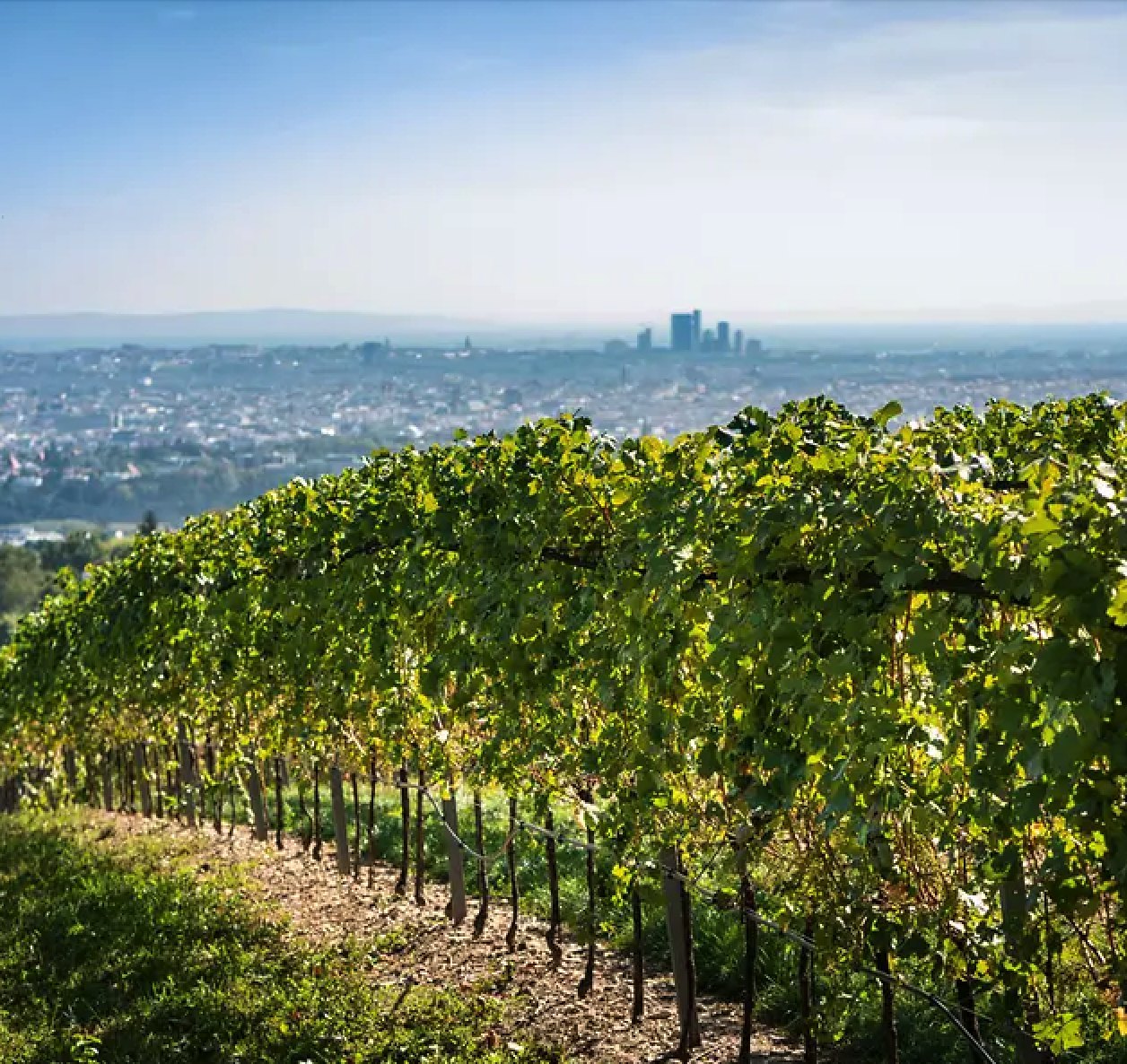
And then a walk of just a few minutes is enough to arrive in a completely different world. Passing Karl-Marx-Hof on the left, Nussdorf opens up, a former wine-growing village. Between narrow lanes, old wine presses and vineyards, two culinary worlds meet here in a way that perhaps only Vienna could produce. In a former vintner’s building, German chef Juan Amador has been cooking at three-Michelin-star level for vintner Fritz Wieninger for years. A few steps further on, you can sit beneath chestnut trees at Mayer am Pfarrplatz, order a Gemischter Satz, Backhenderl or a Jause, and forget for a few hours that a city of millions exists beyond this neighbourhood at all. It is precisely this juxtaposition that makes Vienna unique. On one side, international haute cuisine; on the other, the Heuriger as a social institution. The two worlds are not far apart: barely five hundred metres lie between them. And the fact that Ludwig van Beethoven once lived at Pfarrplatz is not necessarily thrust under the visitor’s nose – delightful!
One station further towards Hütteldorf, where we shall remain from now on, the S45 stops at Oberdöbling. Tram route 38, that legendary Bim which has been running up to Grinzing for generations, is already waiting directly outside the station. It belongs to Vienna just as the Ringstrasse or the Prater do. And it also leads to the place where the city’s image prints itself onto postcards. Heurigers, vineyards, tour groups and tour guides explaining what a Gemischter Satz tastes like before anyone has tried it. Yes: this is the one time we encounter tourists in force.
But we do not have to, because just a few steps from the terminus of the 38 tram lies the winemakers Jutta and Marco Kalchbrenner’s “Buschenschank in Residence”. A Buschenschank such as Vienna had not known for a long time. The menu is small but full of culinary precision. Veal tongue from former Viennese purveyor to the imperial court Thum, sharply marinated calf’s head, excellent cheeses and a cucumber salad without any unnecessary frills. Alongside them are Gemischter Satz, Riesling and Blaufränkisch from their own production: wines without mannerisms, vintages with an astonishingly distinctive signature. They are served by a punky team that could just as easily work in Berlin-Mitte or Copenhagen’s harbour district.
Rather than staying on in Grinzing, however, it is now worth heading back into the city towards Sievering – and back to Oberdöbling station. Suddenly Vienna becomes quieter, very quiet indeed. The Cottage district begins, that upper-bourgeois residential area with its villas from the imperial era, enchanted gardens and old winegrowers’ houses. This is not historic Vienna; it is still alive. The final stop here is a meal at the Eckel restaurant, run by the Zarl family.
Above all, on fine days we sit in one of those restaurant gardens for which Vienna ought to be world-famous, but astonishingly is not. Beneath old chestnut trees, a society that probably exists in this combination only in Vienna or Paris has been dining and drinking here for decades. Long-established Döbling families beside actors, directors and musicians. Conservative regulars beside the cultural scene which, at the latest under Burgtheater director Claus Peymann, made Eckel as much their living room as the Social Democratic reform Chancellor Bruno Kreisky once did. Here they discuss politics, theatre premieres or the latest storm in a teacup. And sometimes nothing at all.
At Gersthof station, the city along the Vorortelinie changes. Here, the S45 runs along a visible boundary. To the right still lies the Vienna that has remained upper-bourgeois to this day. To the left, another, denser and more international Vienna opens up. Hardly any station shows more clearly how close the city’s different worlds of life lie to one another.
We turn right first. The busy Gersthofer Straße seems unremarkable at first glance, almost a little run-down in places. That is precisely what gives it its charm. Beyond it opens one of Vienna’s most beautiful parks: Türkenschanzpark. Its name recalls the Second Siege of Vienna in 1683. At that time, the site was occupied by schanzen, fortifications of the Ottoman army. The park’s name developed from them, and at the end of the nineteenth century it was transformed into an expansive English-style garden landscape. In the part of the park near the station, which follows next, lies the Meierei.
The café-restaurant is one of those places that the Viennese claim fiercely for themselves: families, well-to-do retired senior civil servants, students, young parents with neatly dressed children. Tourists almost never find their way here. The cuisine is more strongly oriented towards the Mediterranean tradition of Viennese cooking than towards the classic traditional pub. Fish, vegetables, pasta and light dishes dominate the menu, accompanied by a glass of wine or a spritzer beneath old trees. It is one of those places where Vienna suddenly feels surprisingly southern. From now on, the city becomes a little more immediate. And another little bit more interesting.
With the next station, Hernals, another Vienna begins. The Gründerzeit palaces have disappeared; instead, tenement blocks shape the streetscape, interspersed with surprisingly beautiful municipal housing estates from the era of Red Vienna. Hernals possesses nothing ingratiating.
If you take the exit towards the city centre and follow Hernalser Hauptstraße for a few minutes, you will arrive at the Wein- und Bierhaus Leopold Brandstätter. It is one of those traditional pubs that have seen little reason to reinvent themselves over the decades. Fortunately. The kitchen serves the Vienna of past generations: goulash, offal too, seasonal classics and, naturally, veal schnitzel. And because Vienna has remained Catholic despite all its modernity, fish is of course available in the reasonably priced Friday lunch menu. At lunchtime, people do not merely eat here; they also drink wine and beer. Quite naturally. The service greets guests with that tart friendliness which tourists (who do not exist here anyway) often misunderstand. Once decoded, it is something one no longer wants to do without. A genuine Grätzel begins all around, the word Berliners translate as Kiez without quite capturing its true meaning.
Diagonally opposite, Café Melmans offers a place where the day could hardly begin better. The espresso machine is among the best in the city, and breakfast is pleasantly free of any staging. Chive bread, an egg in a glass, a Melange, and freshly squeezed orange juice. Nothing more is needed. Here too, the clientele is almost exclusively Viennese. The Vorortelinie has its own rituals.
Just a few steps from the exit of the station towards the outskirts, Ottakring already begins. There lies Kongressbad, one of the most beautiful open-air pools of Red Vienna. Opened in 1928 to plans by architect Erich Franz Leischner, it was considered the city’s most modern outdoor pool at the time. Its red-and-white wooden buildings are listed buildingsc, and the colours of the building consciously quote Vienna itself – red and white, flag and coat of arms. The monumental entrance, clear geometry and surprising lightness of the Scandinavian-looking architecture still tell of a time when municipal pools were not merely places to swim, but expressions of a social promise: beauty should belong to everyone, not only to those who could afford it. Hardly anywhere is the idea of Red Vienna as naturally visible as it is here.
Ottakring, the district and our next Vorortelinie station, still has a reputation that its rows of buildings have long ceased to deserve. Anyone getting off here often thinks first of the city’s best-known brewery, the working-class district and the former Viennese proletarian belt. All of that is true. And at the same time, it has not been true for a long time. Today, Ottakring belongs to those districts where social advancement, old Viennese rootedness and even migration have entered into a remarkably relaxed alliance.
Just a few minutes’ walk towards the city centre from the station lies Gasthaus Gelbmann. For years, the Laskowsky family have run the establishment with that unhurried self-assurance characteristic of great traditional pubs. The cuisine remains true to Viennese tradition, while repeatedly allowing itself small excursions into haute cuisine. Never as an end in itself, but because they know how far a classic can develop without losing its origins. In summer, all of Ottakring sits in the shady restaurant garden. It is no longer merely the old working-class district that meets here: entrepreneurs, doctors, artists and civil servants sit beside families whose parents or grandparents began their social ascent right here. If senior proprietor Hans Laskowsky finds the time, every conversation is worthwhile. Hardly anyone knows the history of Ottakring and the former Viennese proletarian belt as well as he does. His anecdotes almost inadvertently create a small history book of the district.
From Ottakring, we leave the Vorortelinie for a brief detour. Bus route 46A begins directly at the underground station. Just under twenty minutes later, it ends where even many Viennese rarely go: at Schloss Wilhelminenberg. The present building was constructed at the beginning of the twentieth century as the representative villa of an industrialist. Today, the extensive estate houses a magnificent four-star hotel. Certainly, the house has seen more glamorous times. Yet that is now part of its charm. Anyone staying here lives in complete tranquillity above the city and looks out over all of Vienna from the terrace and edge of the garden. Extensive woodland paths through the Vienna Woods begin a few steps behind the palace. In the evenings, young families, students, pensioners and lovers meet in the palace park. A bottle of sparkling wine, a chilled white wine, brought along too, accompany the sunset over the city. At times, when fireworks are set off down in the urban space, it is a rather enchanted place.
From Wilhelminenberg, our route takes us gently downhill on foot towards Penzing through a great deal of dense greenery. It is hard to find anywhere that better illustrates why Vienna looks the way it does today. For the fact that forests rather than motorways and green spaces rather than apartment blocks still take root here is by no means a matter of course. One of the men who played a decisive role in shaping this was called Wolfgang Veit. Today, the spatial planner runs Café International in Ottakring’s Yppenviertel, right in the middle of the creative microcosm around Brunnenmarkt and Yppenplatz. Long before that, however, he belonged to the generation of citizens who opposed Vienna’s almost unchallenged, authoritatively governing SPÖ. Together with citizens’ initiatives, Veit fought against the planned Flötzersteig motorway, an elevated urban motorway that would have cut through western Vienna. The project disappeared into a drawer. Shortly afterwards, Veit also became involved in opposing the development of the Steinhof grounds. Finally, in 1981, the people of Vienna voted against the construction project in a referendum. The extensive grounds surrounding Otto Wagner’s Art Nouveau buildings—yes, the same Otto Wagner who also planned and built the stations of the suburban railway line—were preserved and developed into one of the city’s most beautiful green spaces: a must if we want to fully understand Fin-de-Siècle Vienna. In retrospect, both disputes mark the beginning of that Viennese environmental and citizens’ movement which has since been an essential factor in civil society.
Afterwards, the bus takes us back down to Penzing. Here, the Vorortelinie slowly approaches its end. Shortly before Hütteldorf, it joins the Westbahn, Austria’s railway connection towards Linz, Salzburg and Munich. For decades, Penzing was shaped by the enormous marshalling yard. Shunting locomotives, freight trains and endless rows of carriages defined the scene. Today, the extensive railway facilities are occupied mainly by parked wagons, as if waiting for their their final journey to the scrapyard. Much suggests that this site too will disappear in the coming years. Homes will replace the tracks, urban districts the shunting operation.
With Hütteldorf, the Vorortelinie reaches its western terminus and, at the same time, one of Vienna’s most important transport hubs. Here, S-Bahn, underground, Westbahn and long-distance services meet. Anyone who thinks this brings our journey on and beside the tracks to an end is mistaken. For Hütteldorf tells another story that would scarcely be conceivable without Vienna: the story of football.
Just a few minutes’ walk from the station, the Allianz Stadium of SK Rapid Wien rises up, Vienna’s most traditional football club. Rapid is far more than a club. The association is part of an urban culture that developed over generations. Viennese restaurateur Mario Bernatovic says that the districts along the Vorortelinie once formed the heart of Viennese football. They were the classic working-class districts, where people played in back courtyards, on gravel pitches and in the streets. Those who could not afford a leather ball made themselves a “Fetzenlaberl”, a football made from scraps of fabric and string. From this improvisation emerged a football culture that produced players such as Hans Krankl and Herbert Prohaska – heroes of that legendary Cordoba match against Germany at the 1978 World Cup, which remains part of Austrian folklore to this day.
The story continues to live on today. Bernatovic talks about Admira’s renovated sports ground in Hernals just as naturally as he does about the smaller clubs along the Vorortelinie, whose roots often lie in migration from the former Yugoslavia. They have long since not played in the Bundesliga, yet they often shape their Grätzel more strongly than many a professional club.
In front of the station’s former main entrance, we finally cross the narrow Wienfluss. Within a few steps, we change worlds once again. Hietzing greets us with villas, old avenues and that upper-bourgeois Vienna we already know from Döbling and Sievering. And then, immediately behind it, lies one of the city’s largest natural areas: the Lainzer Tiergarten, once an imperial hunting ground, stretches over more than 2,400 hectares and is one of the most impressive woodland landscapes in Europe located entirely within a city of millions. Those who walk here may, with a little luck, encounter deer, mouflon or the famous wild boar, which locals avoid with healthy respect.
Hardly any other railway line tells the story of Vienna as completely as the Vorortelinie. Between municipal housing and Gründerzeit villas, Heurigers and three-Michelin-star restaurants, football pitches and high culture, tenement blocks and the Vienna Woods, migration and monarchy, it travels through a city that has preserved its contradictions. Being able to visit this part of the city, barely or not at all gentrified, is worth its weight in gold. Not because of any spectacular individual destination. But because of the realisation that Vienna is at its most beautiful where it makes no attempt to be particularly beautiful.