
We remember times – not so long ago, in fact – when wine was an obvious subject for the public. Newspapers had wine pages, magazines covered winemakers, regions, vintages and new developments. They discussed Parker points, natural wine, barriques, the right way to handle Chardonnay and whether a Malbec could ever become as good as a great Bordeaux. Sometimes nonsense was written, too. But at least something was written. Today, the wine industry prefers to concern itself with its crisis. Consumption is declining, cellars are full, young people are supposedly interested only in cocktails and alcohol-free drinks – and the media report on wine above all when yet another statistic announces its impending demise. Or when a health organisation declares that even the first sip is a step towards the graveyard. The industry responds with position papers and demands for better communication – or does not respond at all. This is roughly like convening a working group to improve firefighting-water strategy when a residential building is on fire.
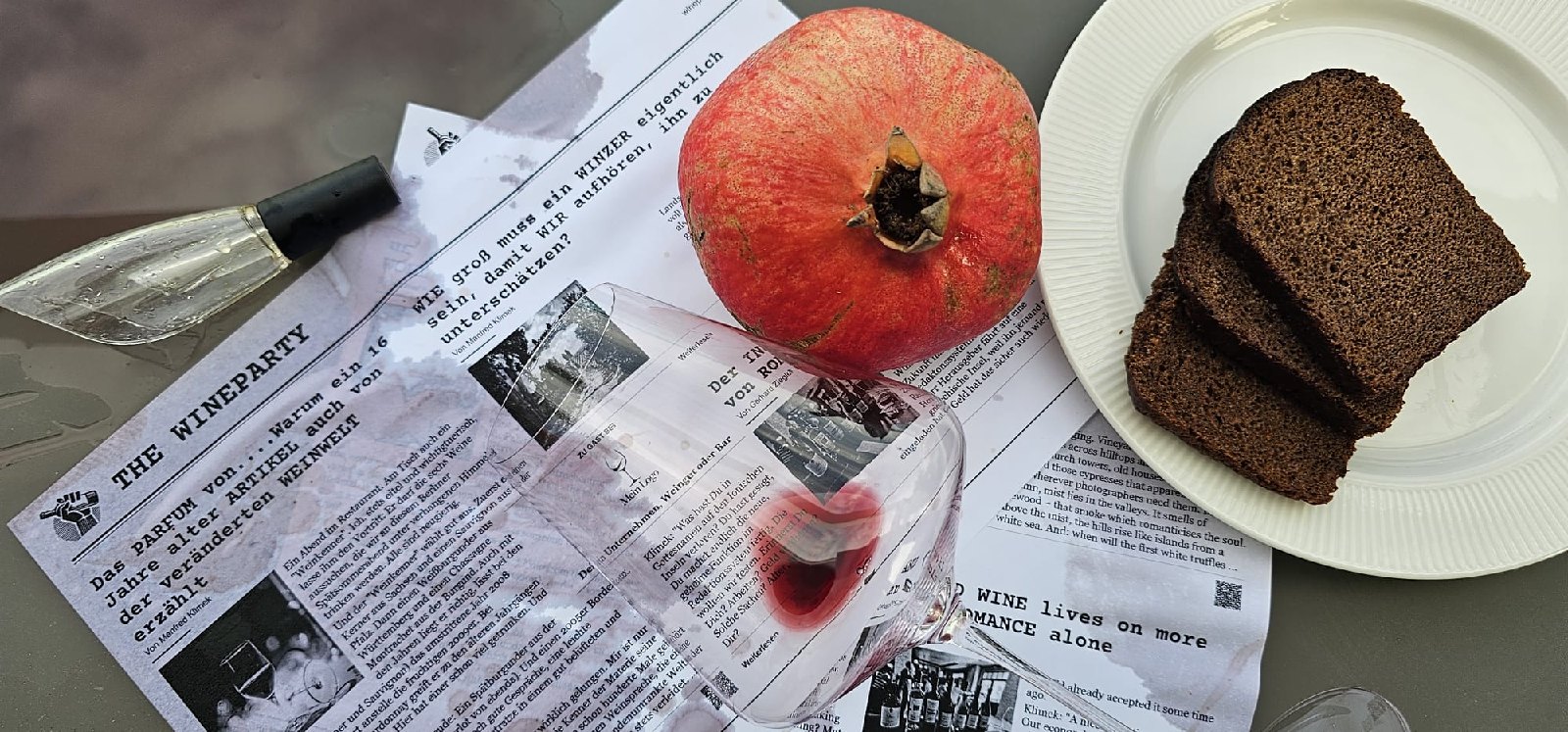
We at WINEPARTY have thought of something else. We are bringing wine back to the table. Literally. From now on, any restaurateur, winemaker, wine shop, wine association or wine merchant can create their own placemats from our articles. Free of charge. With their own name and logo. As a print-ready PDF that can be produced on an ordinary printer or professionally manufactured in a larger print run. To do this, we have developed our own generator. You can select as many WINEPARTY stories as you like, choose one of three layouts, add your logo if desired and specify the paper format. A4 works. However, we recommend A3. Because wine needs space. And so does a good text. The result is a table covering that lies where people should be engaging with wine anyway: in a restaurant, inn, wine bar, wine shop, at a tasting or at the winery itself.
The crucial difference from the usual promotional materials: our placemats actually contain something to read. No nebulous claims about unique moments of enjoyment. No glossy photograph of a winemaker gazing meaningfully into the distance. No three paragraphs about wine being a passion. We know that by now. We provide stories – real journalism. About the people who make wine. About famous and little-known wine regions. About grape varieties nobody remembers any more. About the history of wine, its present, its problems and its occasional absurdities. About large bottles and small businesses. About everything that makes wine interesting once you stop viewing it exclusively as a commodity.
Now let us imagine a perfectly ordinary situation. Four people are sitting in a restaurant. The menus have already been collected, the wine has been ordered and the food is still some way off. One of them reads a story on their placemat about a winemaker they have never heard of. Their neighbour reads something about the crisis in viticulture. The third discovers a text about an exceptional vintage. Suddenly, they are talking about wine. Not about alcohol limits, residual alcohol or whether a second glass is still medically acceptable. But about wine!
It may sound banal. But that is precisely the idea. It becomes particularly interesting when a restaurateur prints different placemats and distributes them across the tables. Different stories then lie side by side. People can compare them, discuss them, disagree, read something aloud to one another. A restaurant does not thereby become a seminar room. It remains a restaurant. But guests are given an additional, very relaxed and never instructive reason to engage with what is in their glasses.
The tool is also intended for winemakers. Anyone organising a tasting can add their own logo to the placemats and lay them out. Anyone running a Buschenschank, Straußwirtschaft or their own restaurant can use them there. Wine associations can make their region of origin visible at events. Large wine merchants and wineries can finance the production of such table coverings for restaurants and appear as sponsors with their logo. This is advertising, certainly. But it is advertising that gives the guest something in return. The restaurateur receives free editorial content for their tables. The winemaker or wine merchant gains an additional opportunity to be seen. WINEPARTY reaches people who may never have visited our website. And the guest gets reading material that, at best, is more interesting than the conversation at the next table. Everyone wins. A rare constellation in the wine industry today. It is difficult to get more win-win than this.
There is, however, a larger idea behind it. Wine has a public-relations problem. And it is one that cannot be solved by better media relations alone. Traditional media devote less and less attention to the subject. The few remaining wine pages often reach people who are already interested in it. The rest of the population mainly hears about wine’s problems. Anyone wanting to reach new readers, new interested parties and, eventually, new wine drinkers must find other ways. We believe that the hospitality industry is one of the most important places for this. Here, wine is not discussed in the abstract. Here, it is on the table. Here, you can smell it, taste it, compare it with food and talk about it with other people. Here, no complicated explanation is needed as to why someone should take an interest in wine. The glass is already in front of them. And that is precisely where we want our stories to go.
We are no longer thinking exclusively of Austria, Germany and Switzerland. For the past two weeks, WINEPARTY has had more international readers than readers from the German-speaking world. For a wine magazine that originally published in German, this is a remarkable development. And it changes the way we view our own work. After all, wine is an international cultural asset. The problems surrounding its public perception do not end at Austria’s border. They concern winemakers in France just as much as those in Italy, Spain, Greece, the USA or South Africa. Everywhere there are restaurants, wine shops and tastings. Everywhere people sit at tables. And everywhere a good story can spark interest in a wine that one would otherwise never have ordered. That is why our placemat generator is also designed for international use. Its interface can be adapted linguistically. The principle works regardless of whether a host is in Vienna, Bordeaux, New York or Cape Town. Select three or four articles. Choose the layout. Add your own logo. Select A3. Download the PDF. Print. Done. Anyone who wishes – and we recommend it – can change the placemats regularly. After all, the stories on WINEPARTY are not running out. And a restaurant that keeps surprising its guests with new texts has created an additional reason for people to return.
Of course, a printed piece of paper will not solve the crisis facing the international wine industry. We are journalists, not miracle workers. And we know that people will not automatically drink more wine simply because they have read something about it. But they must first become interested in wine again. That is the point. An industry that complains that nobody talks about it any more should seize every opportunity to start a conversation itself. The hospitality industry has something that the media are increasingly losing: direct contact with people who want to enjoy themselves right now. We provide the stories. Free of charge. The restaurateurs, winemakers, associations and merchants provide the tables. And the guests decide for themselves whether to read, discuss or simply place their plate on them. That is allowed, too. We would, however, prefer it if they ordered another glass of wine after reading.
Because if wine disappears from the public sphere, it simply has to return to where it belongs: right among the people. And on the table.
Here you can find the free WINEPARTY placemat generator: https://wineparty.wine/tischauflage/