
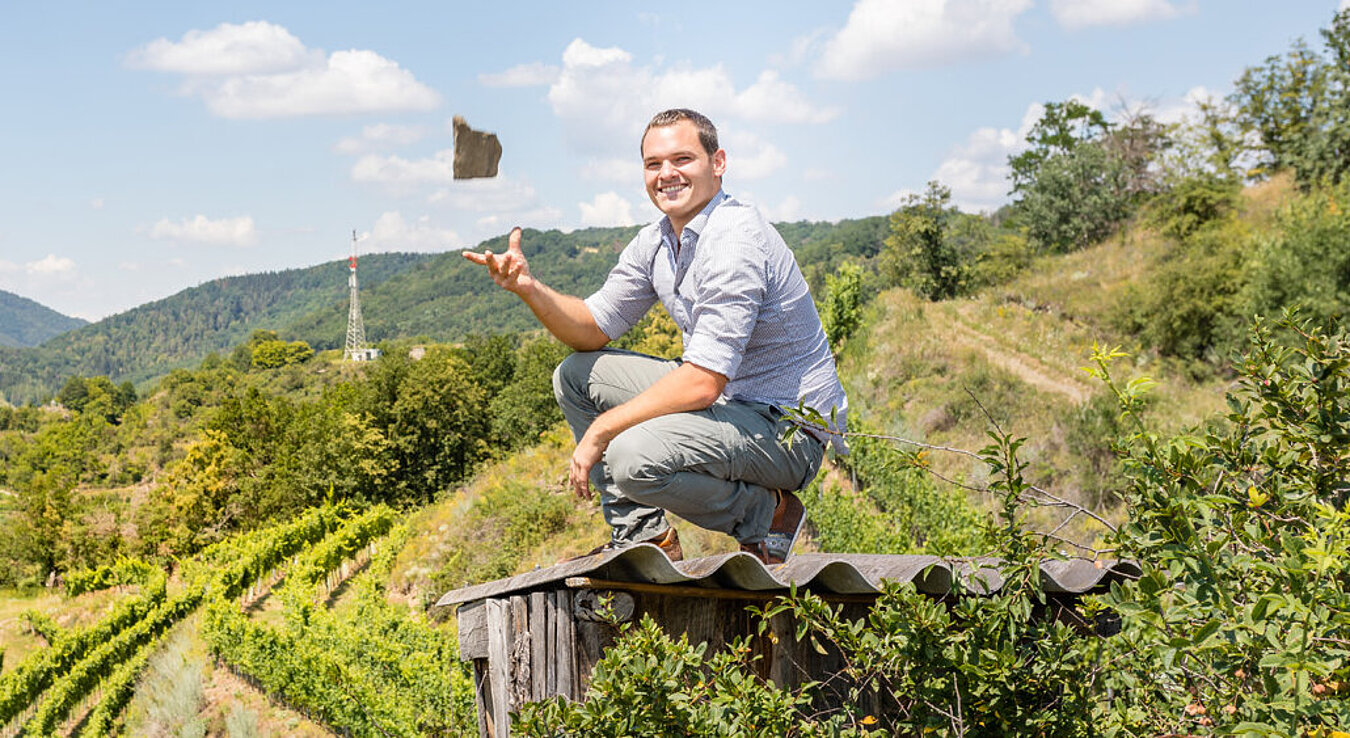
(Manfred Klimek / WELT am SONNTAG)
I am in the Kremstal valley in Lower Austria, where the terroir is often identical to that of the prominent neighbouring region of the Wachau. In Senftenberg, a linear village that actually has more space for rocks than houses, a young winemaker is at work who is currently soaring to the top in the ratings of many wine critics – including those of Robert Parker: Patrick Proidl, 33, quick-witted and as articulate as Heidi Reichinek, with a sharp rhetorical edge; a man who crafts his sentences as precisely as his vineyard plots. The family originally hails from Bremen, having migrated here generations ago and stayed, presumably because the Thirty Years’ War forced them to leave. Patrick’s father, a shrewd, unconventional oenologist with an eternally youthful energy, is still out in the vineyards and down in the cellar every day. Together, they embody something I often find so clearly expressed in Austria: an unpretentious passion that needs no marketing jargon.
Whilst many winemakers in Germany are complaining about falling sales, the Proidls say: ‘We don’t feel any crisis.’ And I believe them. Because those who work in this way do not produce trend-driven wines, but rather documents of their time, which defend their place in the market simply by virtue of their quality and the Austrians’ patriotic drinking habits.
The first wine I taste in the Proidls’ lovely tasting room is the Grüner Veltliner Rameln 2024, a single-vineyard wine from an unspoilt valley, ninety per cent of which is surrounded by woodland. Before the harvest, there are sometimes day-night temperature fluctuations here ranging from 35 to 5 degrees – perfect for exciting wines. On the nose: stone fruit, flint, a hint of damp pebbles. On the palate, apricot dominates – delicate, clear, almost Japanese in its precision. At 11.70 euros, this is an almost too-good-to-be-true demonstration of style and elegance.
The Veltliner Hausberg 2024 is more understated, yet more refined. Limestone gravel, 27-year-old vines, spontaneously fermented. 12.5 per cent alcohol, almost nine per mille acidity – yet you can hardly taste it. It is more elegant, more refined, more chiselled than the Rameln, a wine that does not merely describe the soil, but interprets it.
Then comes the Veltliner Pellingen 2023, Erste Lage, Reserve. A great vintage – sun and clouds in perfect harmony. Harvested just hours before the persistent rain set in at the end of October. Vines aged between 60 and 90 years, own selections, no clones. On the nose: notes of bread, tomato, mustard, a hint of quince and peach. On the palate, it’s plump thanks to the long contact with the whole lees. A wine that breathes like an old musician: deep, round, with dark bass notes. 32 euros – and worth every cent.
The crowning glory comes with the Veltliner Ehrenfels 2023, a monopole vineyard owned exclusively by the Proidls. Once a steep slope that had fallen into disrepair after the war, the Proidls bought it piece by piece from the latifundist Prince von Starhemberg. Hazelnut on the nose, seductive peach and apricot, and on the palate, nut bread, tomato mousse, Paragneis and Bronzit salts. Rich in iron, sensual, almost corporeal. 40 euros – and probably the most full-bodied wine this soil has to offer.
But Patrick Proidl wouldn’t be Patrick Proidl if he were to stick solely to the classics. Then there’s the 2023 Grande Réserve, known as ‘Holzhammer 55’ – 55-year-old Veltliner vines, acacia barrels from Austria, 1,200 bottles. Powerful, but never loud. Stone fruit in all its forms, elegance without excess, 50 euros, and not a cent’s worth of overconfidence.
And finally, the wine that sums it all up: Generation X 2023. 90-year-old vines, gently toasted Allier oak from France, 14.5 per cent alcohol, yet almost weightless. Quince, lychee, mandarin, a hint of walnut, white pepper, yellow pepper. Power and lightness in a single movement – a measured breaking of taboos for a great wine at a modest 50 euros.
I leave Senftenberg with the feeling that something is happening here that can scarcely be captured in figures. It cannot be reduced to the mountain, the winemaker or the brand. Rather, it is a form of viticulture that knows what it is doing – and what it is leaving out.
Patrick Proidl is one of the new voices in Austrian viticulture: quick-witted, alert, self-deprecating – but without any pretence. His wines do not taste of ideological striving, but of confidence in the glass. And yes: Proidl also produces outstanding single-vineyard Rieslings, which likewise deserve close attention. Perhaps next year, then.