
(Manfred Klimek / pic: Bundesarchiv, animation: runwayml)
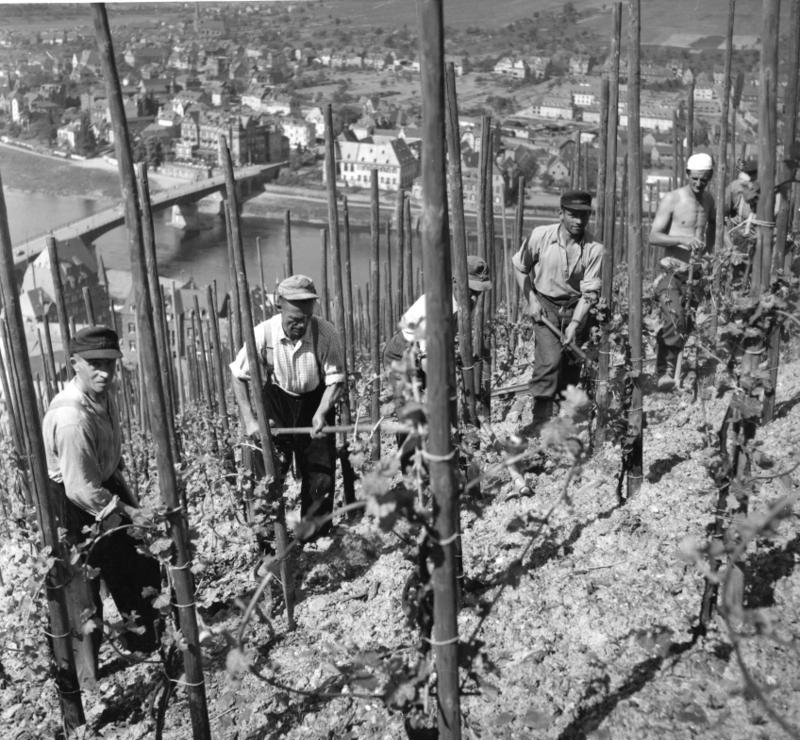
1 May is a day on which we talk about the working class. And about work – manual work, the kind that requires the hands. About production, about classes, about the conditions that push people into certain roles – or enable them to break free from them. And it is a good day to remember that, for a very long time, wine was not a cultural asset of fine distinctions, but an integral part of that material everyday culture which, today and with some detachment, one would describe as pre-modern.
Just fifty years ago, in large parts of the European south, wine was the drink of the working and peasant classes. No luxury, no symbolic charge, but a functional matter of course. More than eighty per cent of the wines made were simple, sweetish beverages – often rustic, rarely faultless, but drinkable, nourishing and accompanying. They stood on the table at midday and in the evening, diluted with water, embedded in a way of eating shaped less by hedonism than by necessity. Here, wine was not a means of distinction, but a source of calories, liquid and ritual.
This practice followed no aesthetic, but an economy. It was an expression of an agrarian way of life in which production and consumption were barely separate. The winegrower and his people drank their own wine, the worker drank the wine from the region. There was no elaborate semantics of taste, no elaborate hierarchisation of sites, vintages and maturation methods. What counted was availability.
With the transition to a late-modern society, this constellation changed fundamentally. The rising new bourgeoisie – economically strengthened, culturally searching – began to adopt this way of life. Not out of necessity, but by choice. Wine, previously for the most part merely a utilitarian good, became an object of reflection. Quality was discovered, differentiated and systematised. And with it came distinction.
What Pierre Bourdieu described as symbolic capital could be observed in wine in exemplary fashion. The choice of wine became a marker of social belonging. Origin, grape variety, maturation – everything acquired significance. Simple table wine disappeared from better-off households, replaced by more complex, “higher-quality” wines that were not merely drunk, but discussed. Wine became a subject of discourse.
This phase shaped modern viticulture. It enabled innovation, established an emphasis on quality and put regions on the map. But it was always exclusive, too. And, in this form, it is over.
The working class, insofar as it still exists in its classic form, today barely drinks alcohol in everyday working life. Labour-law regulations, safety requirements, an increased awareness of risks – all of this has banished wine from production processes. What was once part of the structure of the day is now excluded from it.
Added to this is a demographic shift that is rarely discussed openly. A considerable proportion of today’s working class in many European countries consists of people with a Muslim background. For them, alcohol is not a culturally rooted everyday commodity, but a substance often deliberately avoided. Here, wine loses not only its function, but also its ability to connect.
At the same time, the bourgeois model of distinction is eroding. The grand narratives of better wine, exclusive enjoyment and the connoisseur’s cultural capital have lost their persuasive power. Not because there are no great wines any more. But because the social function they once fulfilled has become fragile. Consumption has become pluralised, fragmented and de-ideologised.
And yet it would be premature to write an obituary from this. Wine has already survived a transformation that was just as radical as the present one. From the everyday drink of workers and peasants to the cultural asset of the bourgeoisie – this was not a linear process, but a rupture. The fact that it succeeded was due in no small part to wine’s ability to recode itself, to take on new meanings without losing its material basis.
Today it is once again at such a point. The market is shrinking in certain segments, habits are changing and social conditions are shifting. But wine’s fundamental quality – its ability to condense place, time and work into a form that can be experienced directly – remains.
It may be that less wine will be drunk in the future. Perhaps, quite probably even, it will change its role once again. But history suggests that it will not disappear. It is too deeply rooted in Europe’s cultural, economic and symbolic structures.
1 May reminds us that all these structures are based on work. Wine included. And perhaps that is precisely where its most enduring form of meaning lies.